The answer depends on where you are. Here is how to decide.
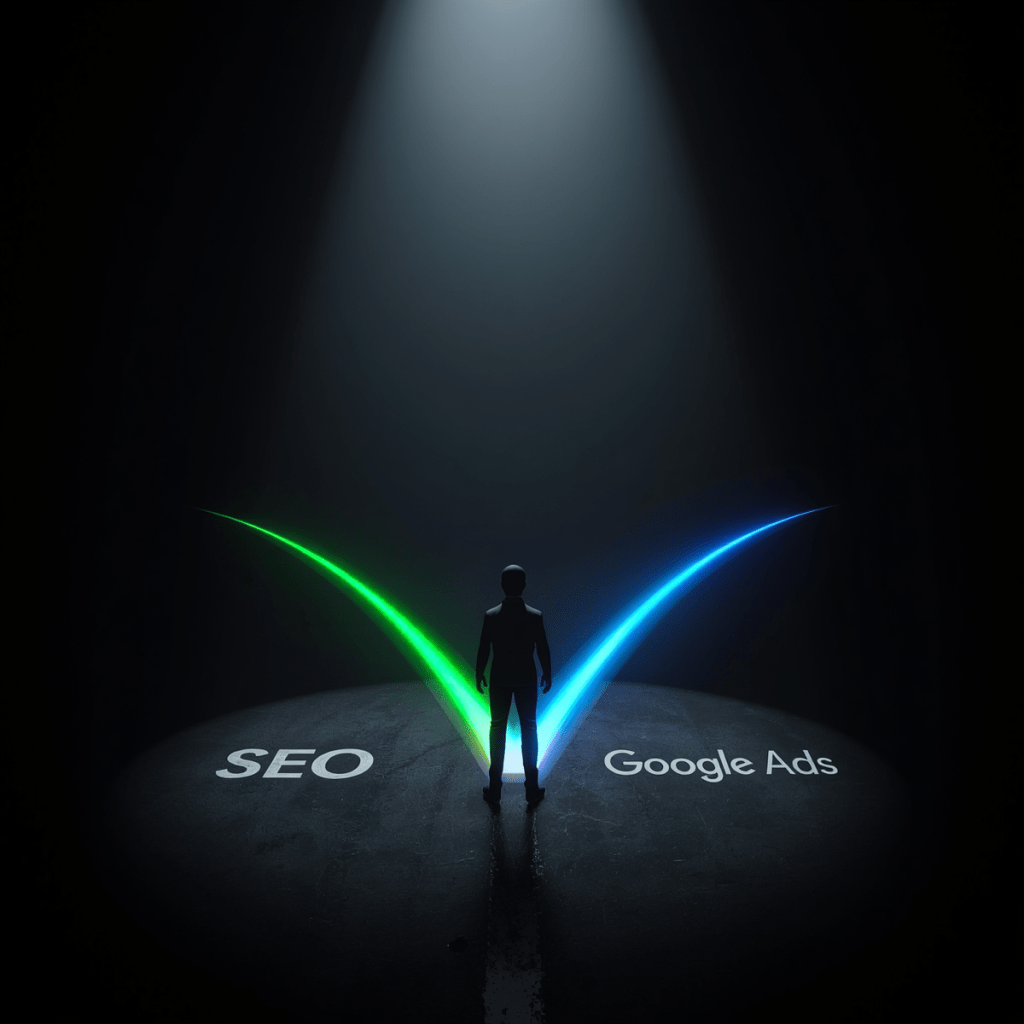
When I was first trying to figure out how to get more clients for my agency, I asked the question that almost every founder asks at some point.
Should I be doing SEO or should I just run ads?
And the answer I kept getting was some version of “it depends,” which is technically true but also completely unhelpful when you are trying to decide where to put your time and money right now.
So here is the version of this conversation I wish I had found earlier. Not a textbook breakdown of what SEO is and what Google Ads is. You already know roughly what both are. What most founders actually need is a clear, honest answer to which one makes sense for their specific situation and why, plus a practical framework for thinking about how the two work together once you are ready to use both.
That is what this blog is.
What Is SEO and How Does It Generate Leads for Your Business
SEO stands for search engine optimization. At its core it is the work you do to make your website and content appear near the top of Google when someone searches for a problem your business solves.
The reason SEO matters for lead generation is intent. When someone types a question into Google, they are actively looking for information or a solution. They are not passively scrolling and stumbling across an ad. They want something specific and they are in the process of deciding who is going to give it to them. If your content shows up at the top of that search, you are not interrupting them. You are meeting them exactly where they already are.
The business case for SEO is compelling because the leads it generates are free. Once your content ranks, it keeps bringing people to your site around the clock without you paying for each click. A single well-optimized blog post can bring qualified leads into your world for years after you wrote it. That kind of compounding return on a single piece of work is unique to organic search.
The trade-off is time. SEO does not produce results overnight. Building authority with search engines requires consistent, high-quality content published over months. For most businesses, it takes three to six months of consistent effort before organic traffic starts to move meaningfully. For competitive industries it can take longer. This is not a reason to avoid SEO. It is a reason to start it sooner rather than later.
The foundational elements of a strong SEO strategy are keyword research, quality content, on-page optimization, and link building. Keyword research tells you what your ideal client is actually searching for so that you can create content that answers those specific questions. Quality content means writing or producing material that genuinely helps the person reading it rather than just trying to rank. On-page optimization means making sure the technical elements of your pages, your title tags, meta descriptions, and page structure, clearly communicate to search engines what each page is about. Link building means earning references from other reputable websites that signal to Google your content is trustworthy and worth showing.
What Is Google Ads and How Does It Generate Leads Faster
Google Ads is paid search advertising. You choose the keywords you want to appear for, write ads targeting those keywords, and pay Google each time someone clicks on your ad and visits your site.
The main advantage of Google Ads over SEO is speed. Where SEO takes months to build, a well-structured Google Ads campaign can start driving traffic to your site the same day you launch it. For a business that needs leads now rather than leads six months from now, that speed matters significantly.
The precision is another advantage. Google Ads allows you to target specific keywords, specific geographic locations, specific times of day, and specific audience demographics. If you are a service business that only works with clients in a particular city, you can make sure your ads only show to people searching in that city. That kind of targeting means your ad spend goes toward reaching people who are genuinely likely to become clients rather than a broad audience that includes plenty of people who will never buy from you.
The trade-off is cost. You pay for every click regardless of whether that click turns into a lead or a client. In competitive industries the cost per click for high-value keywords can be significant. And the moment you stop paying, the traffic stops. Unlike SEO, Google Ads does not build an asset that keeps working after you walk away. It is more like renting visibility than owning it.
For Google Ads to work well, you need three things. The right keywords that your ideal client is actually searching. Ad copy that is specific and compelling enough to earn the click over the other ads appearing alongside yours. And a landing page that is relevant to what the ad promised and designed to convert the visitor into a lead rather than just inform them and send them on their way. A weak landing page is where most Google Ads campaigns lose money. Traffic means nothing if the page people land on does not give them a clear reason to take the next step.
SEO vs Google Ads: Which One Is Better for Lead Generation
This is the question most founders actually want answered and the honest answer is that they are different tools for different situations rather than competitors where one wins.
SEO is better when you are building for the long term, you have time before you need results, your budget for paid advertising is limited, and you want leads that compound in volume over time without an ongoing spend requirement. SEO is the right foundation for most businesses that plan to generate leads from online channels consistently over the next several years.
Google Ads is better when you need leads quickly, you are launching a new offer and want to test whether the market responds to it before investing in long-term SEO, you are promoting something time-sensitive, or you have a healthy budget and want to accelerate growth beyond what organic reach alone can deliver.
The cost-effectiveness comparison is not as simple as most people present it. SEO has a lower ongoing cost per lead once it is established but a significant time investment to build. Google Ads has a higher ongoing cost per lead but gets you to results faster. For a business with no organic traffic and an immediate need for leads, Google Ads is often the more practical starting point even though it costs more per click. For a business playing a longer game with content and brand building, SEO delivers better unit economics over time.
The most powerful approach is using both strategically. Google Ads can drive immediate traffic and leads while your SEO foundation is being built. The data from your Google Ads campaigns, which keywords convert, which ad copy resonates, which offers get clicked, also informs your SEO content strategy. You are not guessing at what your audience responds to. You are using real conversion data to guide where you invest your organic content effort.
How to Use Google’s Free Tools to Improve Your SEO and Lead Generation
Before spending a dollar on any SEO tool or paid campaign, there are three free tools Google provides that most founders are underusing.
Google Analytics shows you what is happening on your website right now. Which pages are getting the most traffic, where that traffic is coming from, how long visitors are staying, and where they are dropping off. This data is your baseline. Without it you have no way of knowing whether any changes you make are improving your performance or hurting it. Setting up Google Analytics before you start any SEO or paid campaign work is the first step.
Google Search Console shows you how Google sees your website. Which pages are being indexed, which search queries are bringing people to your site, and what your average ranking position is for those queries. It also alerts you to technical problems that might be preventing your pages from ranking properly. Search Console is how you find out whether your SEO efforts are actually working and where the biggest opportunities for improvement are.
Google Business Profile, formerly called Google My Business, is essential for any business that serves clients in a specific geographic area. It is what makes your business show up in Google Maps and in local search results. A complete, well-maintained Business Profile with genuine client reviews can drive a meaningful volume of highly qualified local leads without any ad spend. If you serve clients locally and you have not fully built out your Business Profile, it is one of the highest-leverage things you can do this week.
How to Build a Lead Generation Strategy That Uses Both SEO and Google Ads
The mistake most founders make is treating SEO and Google Ads as an either-or decision rather than thinking about how they work together across the full customer journey.
A practical framework for combining them looks like this.
In the early stage when you have minimal organic traffic and immediate revenue needs, use Google Ads to generate leads while simultaneously investing in foundational SEO content. Your ads run on your highest-intent keywords. Your SEO content targets the broader informational searches that your ideal client makes earlier in their research process before they are ready to buy.
As your SEO builds over three to six months and organic traffic starts to grow, you can narrow your Google Ads focus to the keywords and audience segments where paid traffic converts well but organic ranking is difficult to achieve due to competition. You are not replacing SEO with ads or ads with SEO. You are using each one where it does the job best.
Throughout both, you are measuring what matters. Conversion rate tells you what percentage of visitors take the action you want them to take. Cost per lead tells you how much it costs to generate each new inquiry. Time to conversion tells you how long it takes from first touch to becoming a client. These three numbers are what tell you whether your lead generation system is healthy and where the biggest opportunities for improvement are.
The goal of all of this is a predictable, scalable pipeline of qualified leads that does not depend entirely on any single channel. SEO provides the foundation. Google Ads provides the acceleration. Together they give you the kind of lead generation system that compounds over time while also responding to short-term needs.
The Bottom Line on SEO vs Google Ads for Business Growth
SEO and Google Ads are not rivals. They are tools that do different jobs in the same pipeline.
SEO builds a long-term asset that generates leads at an improving cost over time. Google Ads generates leads quickly at a consistent ongoing cost. The right balance between them depends on where your business is, what your revenue goals are, and how much runway you have while you build.
What they both require, regardless of which one you start with, is a clear understanding of who you are trying to reach, what problem you are solving for them, and what action you want them to take when they find you. Without that clarity, neither tool will work as well as it should.
Building that clarity is exactly what we work on inside House of Founders. Because the strategy behind the tools always matters more than the tools themselves.
Ready to Build a Lead Generation System That Works?
If you want the exact content framework I use to attract leads, build authority, and grow without burning out, grab the Short-Form Content Masterclass for $97. Six modules covering everything you need to build a system that generates leads consistently.
Get instant access here: https://aarontran.kit.com/products/short-form-masterclass
If you want to map out your specific lead generation strategy with direct guidance, book a free 30-minute call. We will figure out exactly what combination of SEO, content, and paid strategy makes sense for your business right now.
Schedule your free call here: https://cal.com/aarontran/30min
#personalbranding #hofounders #contentcreator #shortformcontent #founderlife #hofounders
 House of Founders
Leave a comment